I learned calligraphy during my school days. I had opted for Commercial Arts as an elective in our SUPW (Socially Useful Productive Work) course at high school. We started learning with a flat tip pencil and then shifted to an ink pen. I learned and practiced calligraphy extensively for the first one year. I still have my first set of pencils with me, which I do not use very often now. I bought a brand new cut-nib pen set 3 years back and use them now with four different colors of ink. I often use calligraphy to write on various cards and invites. I believe that handmade cards carry more importance and are unique in a way that they touch people’s heart very quickly.
In this post, I would like to share the basics of calligraphy. I would be using cut nib pens in all my posts. One can also use double pencils, felt-tip calligraphy pens (the ones we use on white boards) or quills. Flat paint brushes give the same effect as traditional nibs and are also used at times.
For the examples and pictures in this post, I have used nibs from the “Manuscript classic nib set” which can be purchased at any art store like Michaels. The set consists of five different sized nibs and an ink pen. I could not find the variety of colors for ink cartridges that I was looking for, at the Michaels store. So, I had to purchase cartridges separately from Hobby Lobby.


The calligraphy pen is always held on paper at an angle of 45 degrees.If we drag the pen down towards left, we get thin lines. If we drag it to the right, we get the thickest lines.


The lines of width in between can be obtained by using the pen at different angles.
I learned basic strokes before starting alphabets.
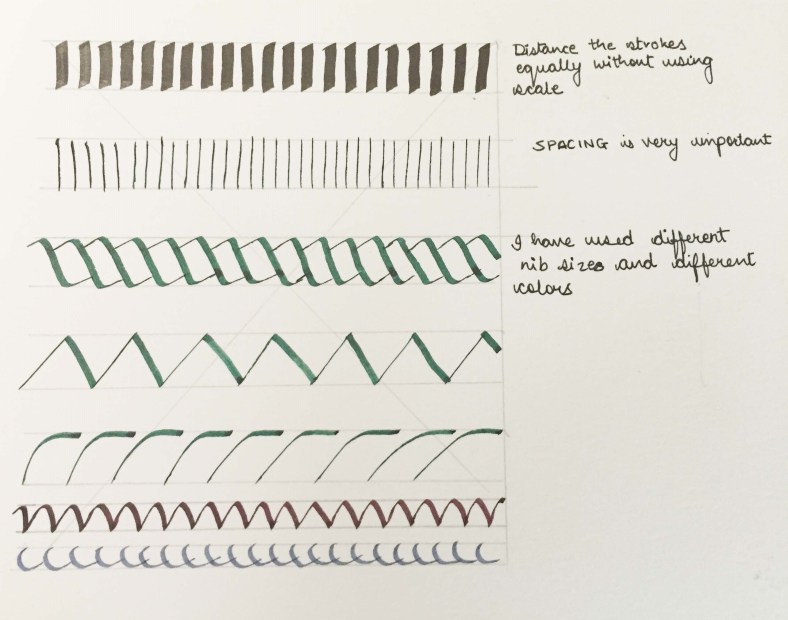
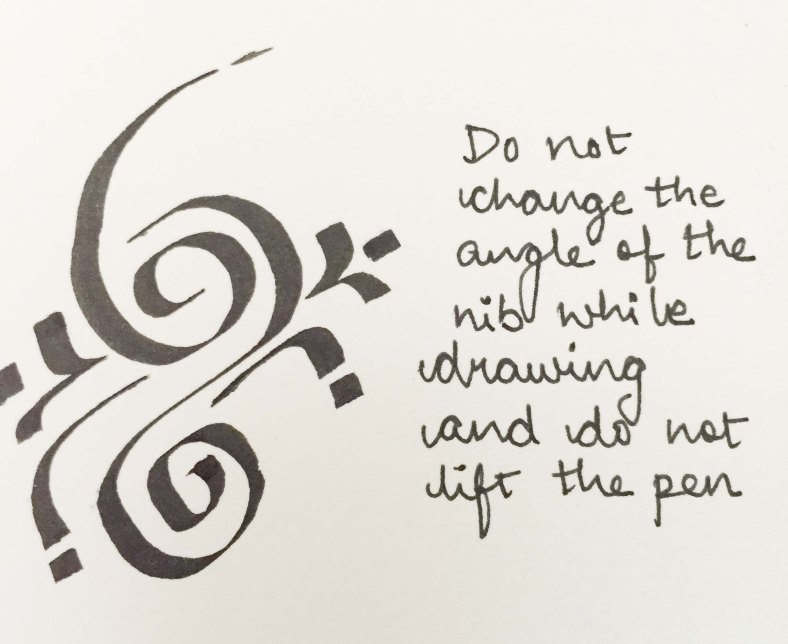
The pen has to be dragged at the same angle without lifting it from paper. Spacing is very important in calligraphy and the strokes should be equally spaced.
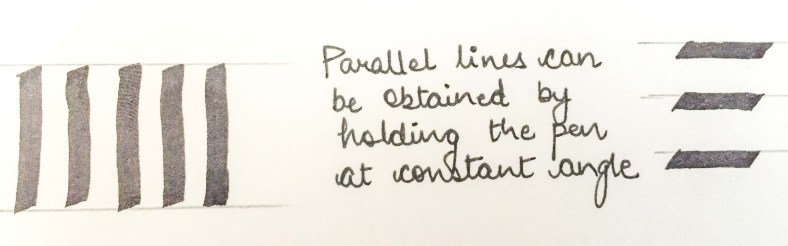
I remember practicing filling rows on A2 size paper for the same stroke till I got it perfect.
Few tips:
- The ink in the nibs dries within a minute. To keep the ink flowing, keep a bowl of water and tissue with you. Dip the nib in water and dab on the tissue (blotting paper) before using.
- Wash the pens before changing the colors, else the other color will be mixed in the ink.
- Always draw lines on paper and write in between the lines, make sure the likes are parallel.
- Be prepared to spoil your hands and dress if you are just starting your journey into calligraphy.
- Perfect fonts will require quite a bit of practice.
I will talk about alphabets in my next post.
Please leave your feedback.
 spectrumdipainte